

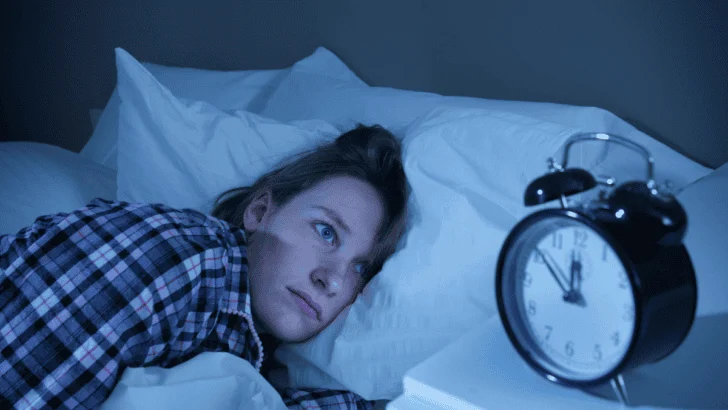


As someone who’s worked hospital night-shifts, I see this pattern all the time: You’re exhausted, but the second you get into bed, your brain decides it’s time for a debrief on your entire life.
So you lie there replaying conversations, mentally writing shopping lists, catastrophizing about things that haven’t happened yet, and checking the clock to do mental math:
“If I fall asleep now, I’ll get five hours… four and a half… four…” And feel your body getting heavier while your mind gets louder.
Sound familiar?
Here’s what’s going on.
Why Your Brain Won’t Switch Off
In sleep medicine, we often describe this as a state of hyperarousal: your body is tired, but your brain and nervous system are still on duty.
Most of us already know the obvious culprits: too much caffeine, a glass (or three) of wine, a heavy meal late at night, or the glare of a screen inches from your face. These can interfere with sleep, but it’s often less about one bad habit and more about the overall load that your system is carrying.
Big life events like moving, break-ups, bereavement, health scares, or starting a new job can all keep your amygdala (your internal threat detector) on high alert, even if you look calm on the outside. The problem is that once you lie down and the external stimulation drops, your brain thinks, “Great, now we can process absolutely everything.”
Sometimes, small changes help more than you’d expect: a protected hour in the evening where work talk and admin are banned, writing down tomorrow’s to-dos before you go near the bedroom, and swapping late-night scrolling for something that doesn’t ping at you every few seconds. You’re not aiming for a perfect, influencer-approved routine; you’re simply sending your body repeated messages that the day really is over.
However, these psychological factors are far from the only cause, and biological factors can play a role as well.
How Hormones Disrupt Your Sleep

Shifting hormones can bring brain fog and a general feeling that your mental filing system is not what it used to be, so it’s not hard to see why the brain might then use the quiet of the night to “catch up.” For example, cortisol (one of the main stress hormones) can start spiking at less helpful times, like three or four in the morning.
Hormones affect sleep for both sexes and at every age, but especially for women in perimenopause and menopause. For example, progesterone has a soothing effect on the brain, and as it drops, it can result in lighter sleep, racing thoughts, and more nighttime waking.
If you suspect that hormones are part of your sleep-deprived picture, it’s a good idea to talk to your clinician about it. Treatment might include basic things like keeping blood sugars stable, eating regular meals with enough protein and fiber, and lowering alcohol intake. In more severe cases, hormone replacement therapy might be an option.
The Impact of Gut Health on Your Sleep

The gut is looked at as just a factor in digestion a lot of the time, but it influences sleep more than most people realize.
In fact, a large amount of serotonin (one of the key players in the sleep-wake cycle) is produced in the gut. The gut is also involved in converting serotonin into melatonin, the hormone that tells your brain “it’s nighttime now.” GABA, a neurotransmitter that helps quiet the nervous system, is also affected by what’s happening in your digestive tract.
So if you’ve had a course of antibiotics or steroids recently, or if you live with ongoing IBS-type symptoms, reflux, bloating, pain, or unexplained changes in your bowel habits, your gut may not be supporting your sleep as well as it could be.
Here, the basics matter more than fancy hacks: Eating regular meals instead of long periods of running on empty, drinking enough water across the day rather than a liter at 10 pm, and paying attention to foods that obviously set your system off (especially later in the evening) can all help.
If gut issues are persistent, painful, or worrying, don’t try to self-manage indefinitely. It’s worth arranging a proper medical check-up and even getting support from a gastroenterologist or a registered dietitian. Sometimes, working on the gut is the missing piece that makes everything else finally work.
Hyperarousal and Your Nervous System on High Alert

All of this (stress, hormones, gut health) feeds into one main control center: your nervous system, which is part of what determines whether your body is in an activated or a calm state.
Both are essential. You need the activated state to get through busy days and unexpected crises, while you need the calmer state to sleep, repair tissue, and fight infections.
At night, of course, you want your body to drift more toward that rest-and-digest mode. But if your system is constantly revved up, that shift is rarely easy. You can be lying flat in bed and still feel slightly braced, like you’re waiting for something to happen. Cue racing mind, shallow breathing, tense muscles, and the familiar combination of being exhausted and wired at the same time.
Simple things like slow, steady breathing through the nose or doing a brief body scan from head to toe can help send vital “you’re safe now” messages to a hyper-alert system. The exact relaxation technique matters less than the intention behind it: you’re giving your brain something calm and repetitive to focus on, instead of letting it spiral into worst-case scenarios.
Medications like sleeping pills can be helpful (and even necessary for some people), especially in the short term. They’re not wrong or “cheating,” but they don’t always address the underlying stress, hormone, or gut issues that keep the brain wired at night.
That’s why many people prefer non-drug options like cognitive behavioral therapy for insomnia (CBT-I), which aim to solve root causes and treat the problem over the long term. Certain technologies can help as well by helping the nervous system shift gears, especially when used alongside the basics of good sleep hygiene.
How Technology Fits Into Your Sleep Routine

Alongside lifestyle changes and simple relaxation tools, some people like to bring in more structured support — which is where devices like Somnee’s Smart Sleep headband come in.
It works by using clinical-grade EEG sensors to read your brain activity, then delivering a 15-minute session of gentle, personalized transcranial alternating current stimulation (tACS) to nudge your brain toward more sleep-friendly rhythms. For sleep-onset issues, Somnee reports that users fall asleep 50% faster, and that in a 6-week NBA pilot (32 participants) average sleep onset dropped to 8 minutes; a small peer-reviewed study also found personalized stimulation reduced sleep onset by 28% (about 6 minutes faster) compared with fixed stimulation.The companion app processes your brainwave and sleep data, then adapts your program and gives you detailed sleep reports over time.
For many tired-but-wired sleepers, this does two key things:
- It creates a healthy ritual of 15 minutes of peace instead of constant doomscrolling. Your body also starts to learn that when the headband goes on, sleep is coming.
- The electrical stimulation works to help people fall asleep faster, wake less often, and spend more time in deeper sleep.
Somnee is drug-free and non-invasive, but it’s worth researching its safety information and speaking to your clinician if you have neurological conditions, an implanted device, heart rhythm problems, or if you’re pregnant.
Of course, it can’t fix everything on its own. It won’t treat sleep apnea or magically cancel out six double espressos. Think of it as one possible support, particularly if you recognize yourself in that hyperaroused, racing-mind pattern and you like having something structured and objective to work with.
Small Changes for Better Sleep

If you recognize this pattern of being desperate for sleep but kept awake by your own brain, it doesn’t mean you’re failing at self-care — it just means that your system is carrying a lot.
Sometimes, it helps to zoom out and ask yourself a few honest questions:
- What might your body still be processing from the day, week, or even year?
- Are hormonal changes or gut issues adding extra noise to the signal?
- What small, realistic changes could you make to give your brain and nervous system a better chance of winding down?
From there, you can start to experiment. Start with a slightly kinder evening routine. One or two relaxation practices you can reach for when your thoughts start sprinting. A conversation about hormones or gut health, if they’re clearly part of the story. And, if it feels like the right fit, add something like Somnee as an extra layer of support.
Just remember: Your body is not trying to sabotage you. It’s trying (in its slightly chaotic way) to keep you safe. And the more clearly and consistently you can show it that nighttime really is a safe enough place to switch off, the easier it becomes for your brain to finally stop running the show at 3 am.