



While his specialty is sports rehabilitation, his diverse patient base pulled him into an unexpected focus: sleep quality. From obstructive sleep apnea to chronic insomnia, Trevor has committed himself to understanding the conditions that steal restful nights, because sleep doesn’t discriminate. It affects everyone, from the stay-at-home parent squeezing in weekend workouts to the elite athlete chasing peak performance.
When he’s not treating patients or reviewing sleep solutions, Trevor is with his family, coaching soccer, or spending time at the beach. His best sleep hack? Keep a consistent wake-up time, even on weekends. Your body’s internal clock thrives on routine, and once it locks in, falling asleep starts to feel like the easy part.
- Best Inspire Alternatives - August 31, 2026
- Best Tongue Stabilizing Device for Mild Sleep Apnea - April 13, 2026
- Tongue Strengthening Device vs Mouthguard: Which One Actually Fixes Snoring? - April 13, 2026
I’ve battled inconsistent sleep for years. And as a doctor who’s always been fascinated by the science of sleep, I’ve experimented with just about everything, from melatonin gummies to meditation apps.
Without any lasting results, and with encouragement from my wife (more of an ultimatum, really), I was excited to find wearable devices that are backed by real neuroscience, directly targeting brainwaves to help you fall asleep… and stay asleep.
Both Somnee’s and Elemind’s headbands promise to improve your sleep using personalized stimulation, but they do it in fundamentally different ways. Somnee uses direct electrical modulation, while Elemind uses auditory pulses. I wore each for weeks, tracking my sleep with their apps and even cross-referencing with my old Apple Watch reports.
Here’s what I found, along with citing some of the science, clinical studies, and my own professional experiences as a doctor.
Understanding the Brain’s Wavelength Patterns: Why Modulation Matters

Before we get into the devices, let’s talk about brainwaves. These are electrical rhythms that constantly fire off, facilitating everything your body does: from alertness and movement to deep slumber and rest.
Think of them like an orchestra. When it’s time for sleep, you want the “wakeful” signals (like alpha waves, which signal relaxed but alert states at around 8–12 Hz) to quiet down and let the “drowsy” ones (theta waves, 4–8 Hz) take the lead. When one instrument plays off-beat or in the wrong key — whether due to stress, screens, or physiological disruptions — it can lead to poor sleep.
Traditional aids like pills can work to calm your active signals indirectly, but electroceuticals like Somnee and Elemind use EEG sensors to read your unique patterns and then attempt to influence them in real-time. The key difference? Somnee speaks the brain’s native language (electric activity) using transcranial alternating current stimulation (tACS), while Elemind uses sound that your brain has to translate via the auditory system. This translation step can make auditory modulation less efficient, as it relies on your inner ear anatomy and neural pathways to interpret the signals — potentially losing precision along the way.
In my experience, this made a noticeable difference in consistent results.
Both devices are non-invasive, safe, without any side effects, and drug-free. They’re headbands you wear before bed, with mobile apps for in-depth insights. But let’s dive into each.
Somnee vs. Elemind: At a Glance
| Somnee | Elemind | |
| Mechanism | Electrical currents directly modulate theta/alpha waves; no translation needed | Sound pulses timed to alpha waves; the brain translates via auditory pathways |
| Personalization | AI maps unique EEG over sessions and adjusts currents to your individualized peaks | AI refines based on alpha detection and feedback |
| Session Length | 15 minutes pre-bed; optional overnight tracking and “Driftback” session | Up to 30 minutes; overnight for insights |
| My Personal Improvement in Sleep Onset Latency (SOL) | Down to <10 min consistently. | Inconsistently down to 3 min at the lowest |
| Sleep Depth/Duration | Increased by +30 min, fewer wake-ups, deeper feel | Increased by +10–15 min |
| Sensation/comfort | Light tingle; adjustable soft fabric | Subtle scratchy sounds; lightweight, minimalistic |
| Price | $489 + a $160/year membership | $349 + optional $12/month app |
| Best For | Chronic issues or optimization; direct, reliable modulation | Onset issues (getting to sleep); good if you prefer no physical sensation |
Somnee
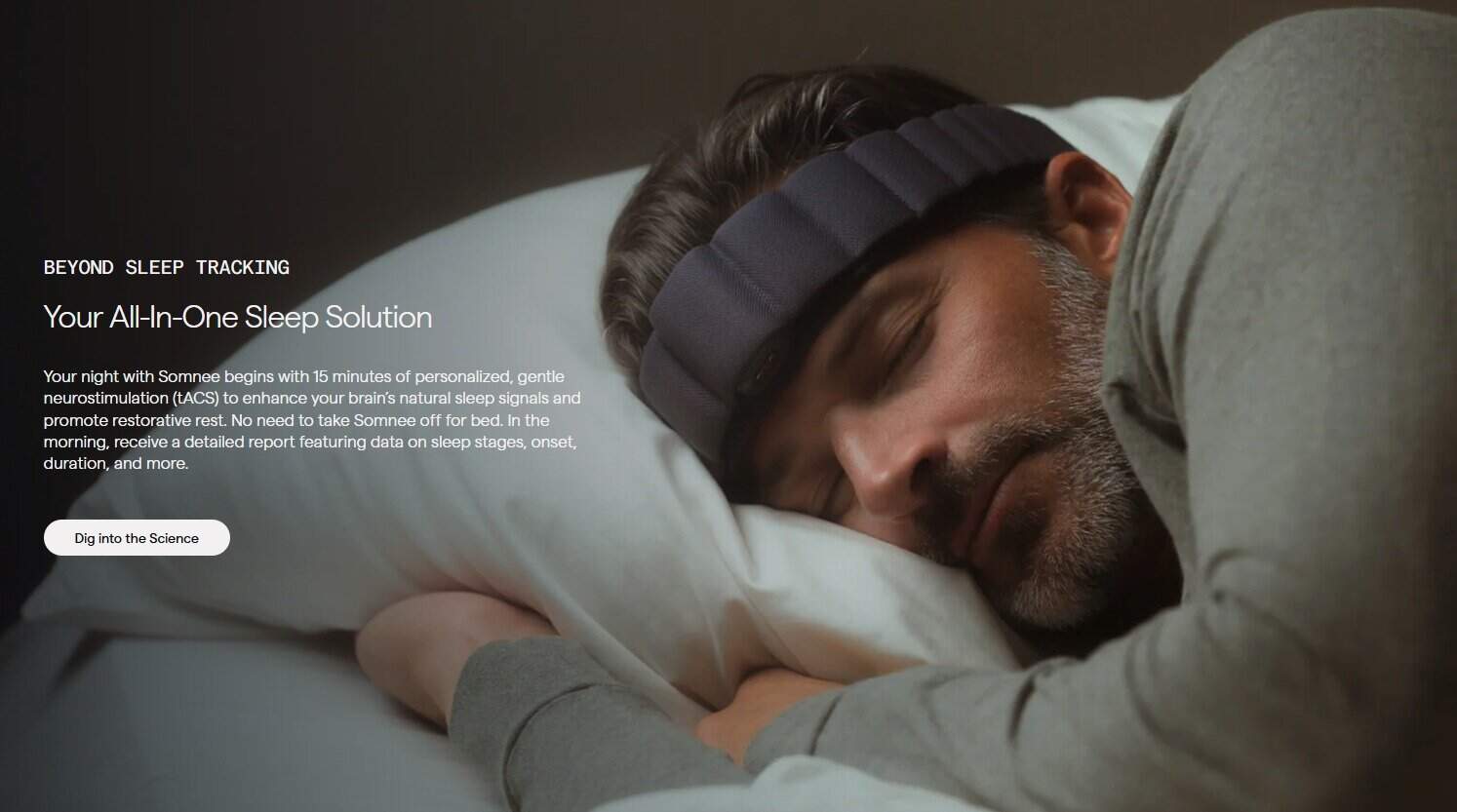
Developed by UC Berkeley neuroscientists, Somnee’s headband was the first one I tried. It uses tACS to guide brainwaves into restorative sleep patterns. Research shows that this kind of personalized stimulation for 15 minutes before bed can improve sleep efficiency (how much of your time in bed you’re actually sleeping) by 13.4%, reduce sleep onset latency to 6.7 minutes, and increase total sleep time by 26.3 minutes.
Here’s how it played out for me:
Setup and Personalization
Somnee’s headband is an adjustable fabric wearable that fits snugly with soft Velcro straps. The comfort took a few nights to get just right, and I adjusted pillows and straps more than a few times, but now it’s seamless.
Over the first week, its EEG+ sensors mapped my brainwaves during each session. For 15 minutes before bed, gentle currents flow through forehead electrodes. It felt like a very subtle tingling — if I wasn’t looking for it, I didn’t feel it. The headband analyzed my theta and alpha wave peaks, creating a custom “sleep sweet spot” profile. This was one of the coolest parts, and you can even choose to let it play calming neural soundscapes via bone-conduction speakers during your session.
For the first couple of nights, I was unsure whether it had even worked. But by night 7, there was a noticeable difference. My average sleep onset latency dropped from my usual 20–30 minutes to under 10. I was waking up maybe once or twice during the night instead of my usual four, and my total sleep time jumped by about 30 minutes.
The app’s tracking felt way more accurate than my Apple Watch, and it even does a “driftback” session for 10 minutes in case you wake up in the middle of the night, which I found moderately effective.
Overall, after using Somnee for a week, I felt refreshed and wasn’t nearly as groggy in the morning.
Pricing: At $489, it includes the headband, a good supply of electrodes, and a 6-month membership that auto-renews at around $160/year unless canceled. This membership includes access to all app features, powerful AI tools, and monthly hydrogel electrode replacements (the app wants you to change the electrodes every couple of days, so you go through a lot of them in a month). It’s HSA/FSA eligible, they offer a 45-day risk-free trial, and there are discounts available for military, teachers, and first responders.
Elemind
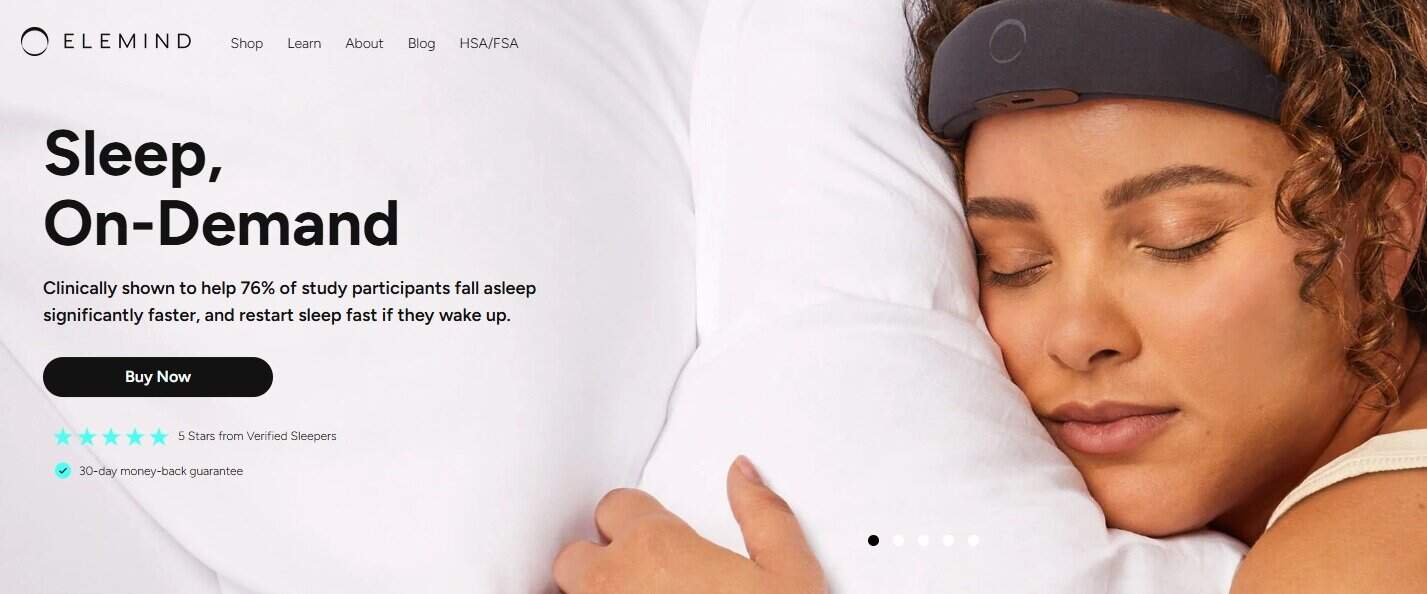
Elemind, which finds its origins at MIT, caught my eye next as it suggested “sleep on demand.” Unlike Somnee, it uses bone-conduction audio (sound waves that vibrate through your skull, not ears) to modulate brainwaves. It also uses five EEG electrodes to monitor your brain and gauge the quality of your sleep.
When it detects high alpha (wakefulness), it sends timed pink noise pulses anti-phase to your waves, aiming to disrupt alertness and promote sleep. This sounds like subtle bursts that aren’t loud by any means, but they are audible. These noises influence neural activity indirectly — it’s like noise canceling the brainwaves that keep you awake.
My initial setup was somewhat challenging. The app seemed like much more of a budget solution, and I had a somewhat clunky experience pairing my device to my phone/app.
It did, however, help me fall asleep faster, down to just three minutes at times. My efficiency was also up from baseline but down from my experience with Somnee. Also, when I did wake up in the middle of the night, a quick session restarted sleep, but not as effectively as my initial session.
One thing I did like was that I was able to get the device to continue to work as long as I needed to, with multiple sessions a night if needed. This was different from the Somnee headband, which limits you to just two sessions each night total.
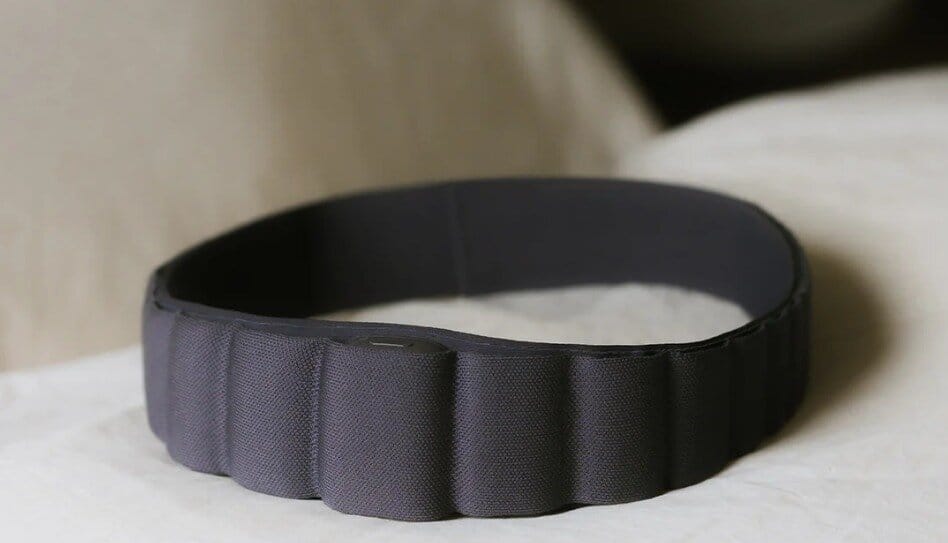
Overall, my sleep quality improved, but it was inconsistent; I definitely didn’t get the same depth or duration boost that I had with Somnee. My total sleep time increased by maybe 10-15 minutes, and I still woke up feeling a bit groggy some days. But mostly, the auditory layer was the hitch for me. If I was overstimulated or was having a sensitive night, the scratchy pulses felt less effective. The comfort was great, though. It was light and minimal around the back of the head and the ears, which is where I experience most of my discomfort as a side sleeper.
Pricing: Elemind’s solution is priced a bit cheaper, at $349 for the headband and an optional $12/month app membership for advanced features like deep sleep tracking. However, it only comes with a 30-day guarantee instead of 45 days.
Which One Should You Try?
After recording dozens of nights with each, Somnee is the one I still keep on my nightstand. While I got to sleep faster with Elemind’s wearable, falling asleep wasn’t as important to me as consistently high-quality sleep that carries alertness and productivity into my day. As a doctor myself, I need it, and my patients rely on it.
The different mechanisms they use make the biggest difference here: Somnee’s tACS delivers electrical signals directly, mimicking the brain’s own currents for precise communication. Elemind’s sounds are innovative but indirect, and with the added auditory translation layer, it’s just not as reliably effective as tACS. Somnee’s app also gave me detailed insights via AI analysis and reports, which provided education in addition to a more restful sleep.
So if you’re a sufferer like I was, tired of pills and sleep hacks, Somnee’s electrical modulation really delivers. Elemind is solid for entry-level neurotech, especially at the price, but its auditory indirectness left me wanting more.
Both come with trials, so test them out for yourself! Your rested self will thank you.