


- Titan vs Big Fig: Picking a Heavyweight Mattress Champion - September 18, 2026
- Eight Sleep vs. Molecule Mattress - May 19, 2026
- Eight Sleep vs. Serta iComfort - May 16, 2026
When I last moved, I realized the guest room mattress I had wasn’t going to cut it for the visiting family who were each over 250 pounds. Most mattresses are tested for a 250-pound limit, so whether you are a bodybuilder or have more dormant muscle, it’s important to pick a mattress with the right weight capacity, internal spring design, edge support, and warranty.
Choosing the Right Heavy-Duty Mattress: A Head-to-Head Comparison for Plus-Size Sleepers
Heavy-duty mattresses are engineered from the ground up with high-density foams, robust coil systems, and reinforced bases to provide authentic support. Two of the absolute titans in this purpose-built market are the Titan Plus and the Big Fig (Their tagline is “The Mattress for Bigger Figs,” which I love).
While both mattresses work for heavier sleepers, they utilize vastly different design philosophies. So I’m going to analyze how these two heavyweight contenders stack up across critical performance categories, including edge support mechanics, weight capacity claims, warranty signals, and motion isolation for couples of different weights.
The Core Design Philosophies
Before diving into specific performance metrics, let’s look at the internal construction. I like to refer to this as the core design philosophy because the way the mattresses are designed reflects the internal components that the company values most.
Titan Plus: Engineered Firmness and High-Density Value
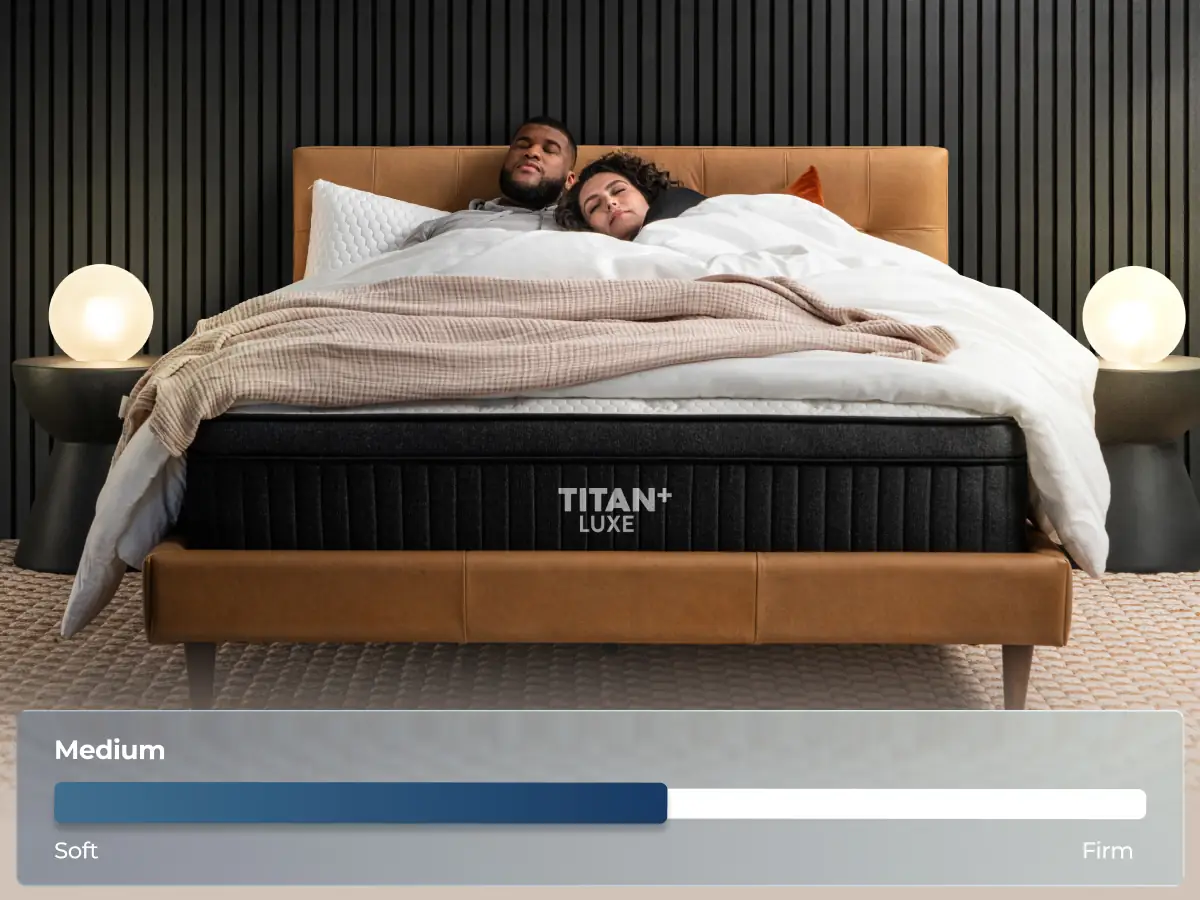
The Titan Plus is an all-hybrid mattress designed specifically to provide a flat, highly supportive surface that resists deep sinking. It is 11 inches tall and features a streamlined, industrial-strength build.
For starters, you get a quilted top with 1 inch of gel memory foam designed specifically to provide immediate pressure relief. You have the option of adding their GlacioTex™ cooling cover if you tend to sleep hot.
Underneath that is 2 inches of patented TitanFlex™ foam. This hyper-elastic material combines the contouring properties of memory foam with the quick recovery of latex. I don’t personally like full memory foam in isolation because I always feel like I’m sinking into the foam and I can’t breathe or get out from under it. This hybrid material helps fix that.
You also get 8 inches of individually wrapped TitanCaliber™ coils. These are heavy-gauge steel coils, and they are doing most of the heavy lifting, pardon the pun. They are industrial-grade and created to withstand severe weight without bowing or flattening. Underneath that sits the final layer, a base of 1-inch high-density foam that gives your industrial coil system something to push against.
I love how it all works together.
Big Fig: Heavy-Duty Indestructibility and Tufted Security
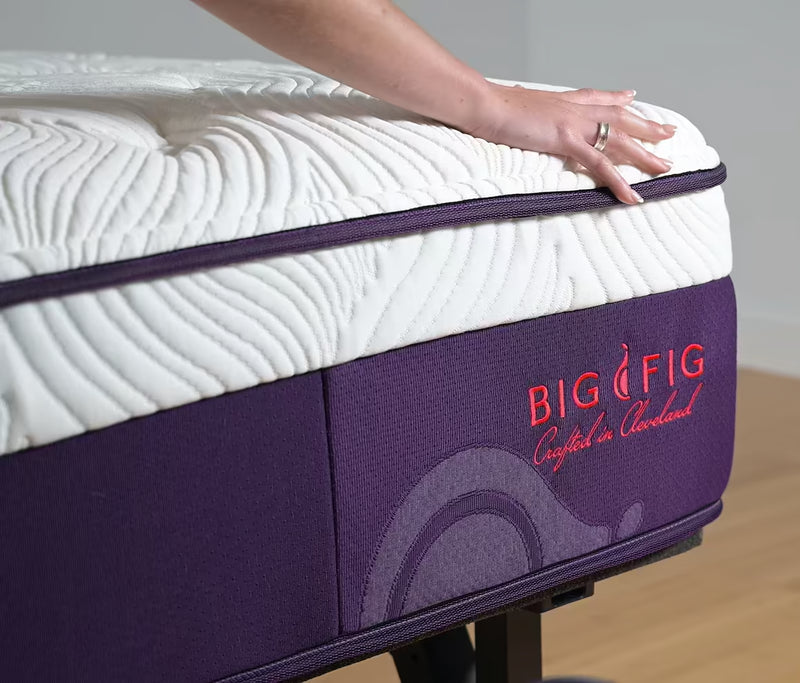
Big Fig, on the other hand, is a bit taller, which means there is more to unpack inside. At 13 inches tall, this mattress is engineered with a heavy emphasis on structural prevention. Basically, it uses mechanical fastening and extremely dense foams to actively fight shifting and sagging under high weight.
On top is the breathable cover made with ThermoGel cooling technology to actively dissipate body heat. Crucially, the entire mattress is hand-tufted in 16 places. This means that the tufts are pulled entirely through the bed from top to bottom instead of just one layer to the layer beneath it. This binds the entire system together to lock all the layers where they sit and prevent them from shifting as you use your mattress.
Think of this as the buttons that are pulled through every single layer of a fancy winter coat to hold wind-resistant material, waterproof material, and down material together.
Beneath that, you get multiple layers of heavy-duty poly-foam and a layer of perforated gel latex. The latex provides immediate push-back and airflow, while the poly-foams can support significantly higher weight than standard foam. Inside the core are 1,600 individually wrapped coils (in a king size) made from 15 gauge, high-tensile steel. It uses a much higher coil count than typical hybrid mattresses to distribute heavy weight. And at the base, you’ll find the ultra-dense foam.
Edge Support Mechanics: Getting In and Out of Bed
For plus-size sleepers, edge support is one of the most critical structural features of a mattress. On a standard bed, if you sit on the edge or lean on it with your arms, it can cause the perimeter to collapse, and then you sort of melt/slide onto the floor. As cute as this sounds, I promise from personal experience, it isn’t.
More importantly, we sit on the edge of our mattress to do just about everything from putting on shoes to getting dressed, to just getting in and out of bed. So as your body mass gets concentrated over that narrow surface area, it starts to slope, and this can force your joints to work twice as hard to get you from a sitting to a standing position and vice versa.
That’s why I focused on how Titan Plus vs. Big Fig stack up when it comes to good Edge support.
Titan Plus Edge Support Performance
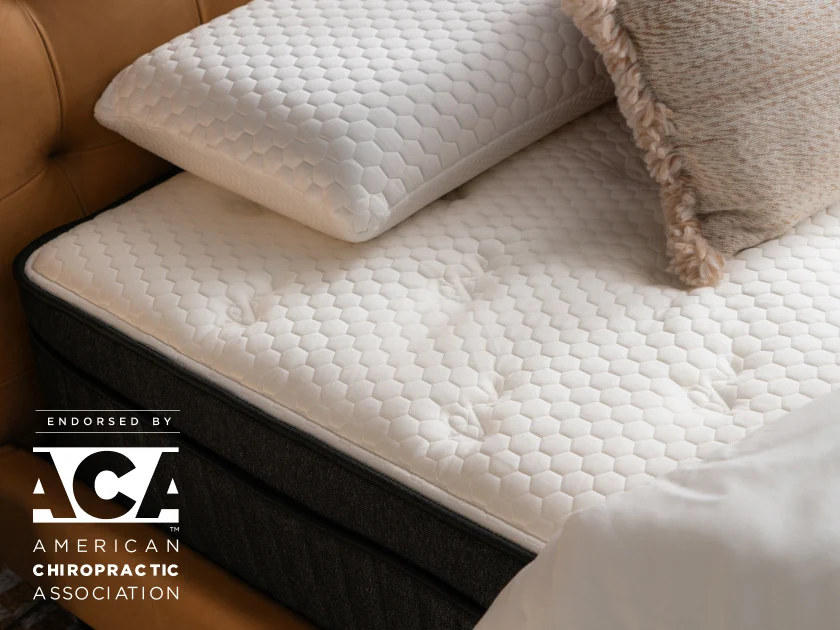
The Titan Plus tackles edge support pretty impressively. The company employs uniform coil tension and high-density foam encasement. Because the TitanCaliber™ coils are exceptionally stiff throughout the entire perimeter, the mattress behaves like a solid platform.
When I sat directly on the edge of the mattress, I didn’t notice any type of sagging. The high gauge steel coils didn’t bottom out and instead basically made a firm bench that I could sit on. That “bench” feeling was exactly what I wanted, and it’s exactly what my in-laws want: an easy way to get in and out of bed despite hip mobility limitations.
That same sort of “bench” also means no one will accidentally find themselves rolling out of bed and sleeping on the floor. You can basically sleep with your shoulder pressed directly against the edge of the mattress, and it will still feel completely level and secure with no roll-off sensation.
Big Fig Edge Support Performance
The Big Fig utilizes a massive, ultra-firm foam perimeter system too, one that wraps around the entire 1,600 coil core. It uses some of the densest foam edges found in the direct-to-consumer bedding industry.
When I sat on the edge of this mattress, it barely moved. The foam walls were so rigid it actually felt like I was sitting in a chair, and not one of those fluffy chairs you get in a cozy cafe, but the rigid chairs you get at a university library.
If you are the type of person who tends to push yourself off your bed to stand up, this will give you that vertical stability you need.
Decoding Weight Capacity Claims
Mattress marketing is flooded with weight capacity claims, but plus-size buyers learn to read between the lines. A mattress manufacturer claiming a “500-pound capacity” does not mean the mattress will feel comfortable at that weight; it simply means the mattress will not structurally break down under that load in an oh-so-comical-Stepbrother-scene.
So if you want to know what the actual weight capacity is for Titan Plus vs Big Fig or really any heavy sleeper mattress, you want to look at two distinct metrics: per-sleeper weight capacity and total structural capacity.
True purpose-built options design their coil gauges, coil counts, and foam densities around these metrics to ensure the comfort life of the bed matches its physical lifespan.
Titan Plus Weight Claims and Real-World Scaling
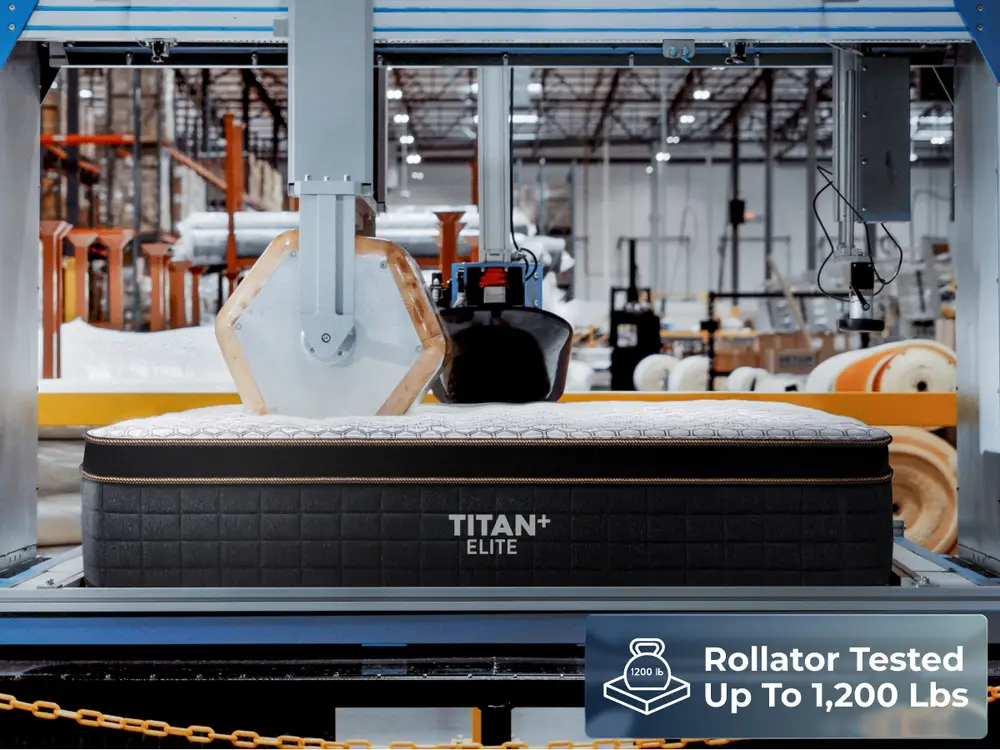
The Titan Plus is rated to support up to 500 pounds per side, for a total combined weight capacity of 1,000 pounds.
The company gets this rating by using the 13.5 gauge coils, so the slightly lower gauge number results in thicker and stiffer steel. This means the 13.5 gauge coil is incredibly robust, especially compared to standard mattresses that use a 15 gauge steel coil or higher.
It also scales very well up to that 500 pound limit because it has the stiff steel and the high-density comfort foam. However, if one of the two sleepers in your bed is under 200 pounds, they simply won’t have the weight to compress any of those steel coils, so it will feel like sleeping on a board.
Big Fig Weight Claims and Real-World Scaling
The Big Fig goes a step further in its formal testing, claiming a weight capacity of 550 pounds per sleeper, for a total combined weight capacity of 1,100 pounds.
They reach this threshold because of the higher coil count. They don’t have thicker or stronger coils, but instead they have a denser matrix of 15 gauge coils, which distributes the weight across the surface a bit better than regular 15 gauge mattresses.
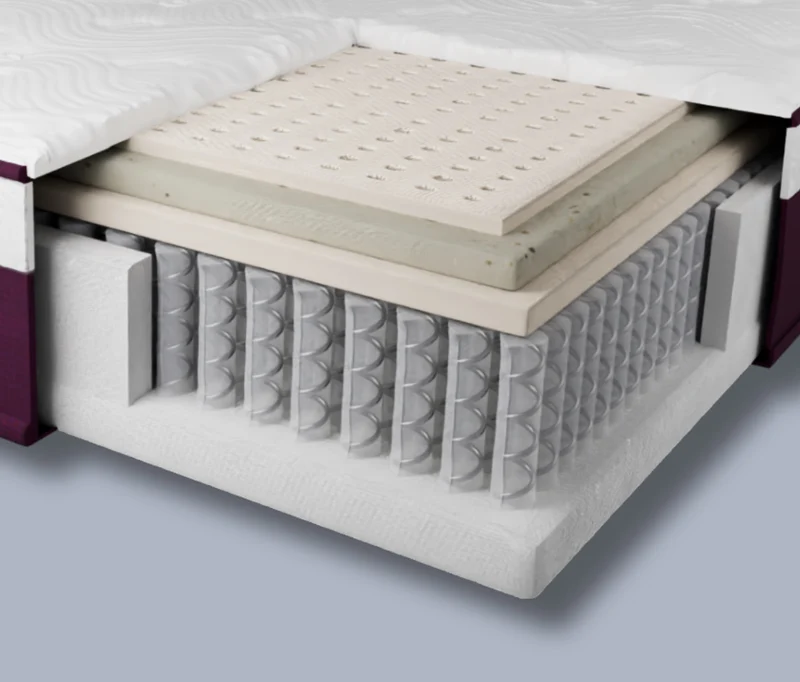
Like the Titan Plus, it is an inherently firm bed. However, because it incorporates a layer of perforated gel latex near the top, it offers a tiny bit more surface contouring before you hit the unyielding support of the coil system.
I mentioned that sleepers under 200 pounds might feel they are sleeping on a board with Titan Plus, and that’s even more so the case with Big Fig. This mattress is specifically optimized to prevent the “hammocking” effect for sleepers near or above the 400 pound mark, so anyone substantially under that mark might as well sleep on concrete.
Warranty Length Differences: What They Signal
When you look at the warranty they offer, you’re looking at how much faith each company actually has in their materials when exposed to intense, long-term stress. For me, the biggest thing to look at is the sagging threshold. This is the fine print in your warranty that stipulates the depth of a permanent indentation that your mattress has to reach before the company will acknowledge there is a defect and send you a replacement.
Titan Plus Warranty Analysis
The Titan Plus comes with a 10-year warranty. Importantly, this warranty covers permanent sag or body impressions that measure 1.5 inches or greater.
But an indentation of even 1 inch or 1.25 inches can be noticeable enough that it causes an uncomfortable dip in your mattress and problems with your spine alignment, and it wouldn’t qualify for coverage under your warranty.
That doesn’t mean the warranty isn’t worth it or the company is substandard in any way; it’s just something to note when you look at that sagging threshold.
Big Fig Warranty Analysis
The Big Fig comes with a 20-year warranty. And by comparison, not only is that twice as long, but the threshold is 1 inch or more. I definitely like this warranty better because it not only drops the threshold by half an inch, which is noticeable, but it also doubles the timeline, so this company is making a very bold statement about their engineering, and it signals that they expect their mattress to stay just as supportive and firm as the first day you get it. To me, it indirectly signals that they stand by their products for twice as long as their competitors.
Handling Mixed-Weight Couples
Now I already briefly touched on how both of these mattresses can feel different for someone under 200 pounds, but I want to dive into that a bit more because a couple that has a lightweight partner and a heavyweight partner will face distinct challenges picking their mattress.
A standard mattress will create a deeper compression for the heavier side, which means the lighter partner ends up sloping or rolling toward the middle of the bed. But if the mattress is too firm or rigid, then the heavier partner sleeps like a baby while the lighter partner might experience some pressure points along their shoulders and hips.
The ideal combination here is something that compresses enough for the heavier partner that it doesn’t pull the surface area around them, with enough plushness for lighter sleepers.
Titan Plus for Couples
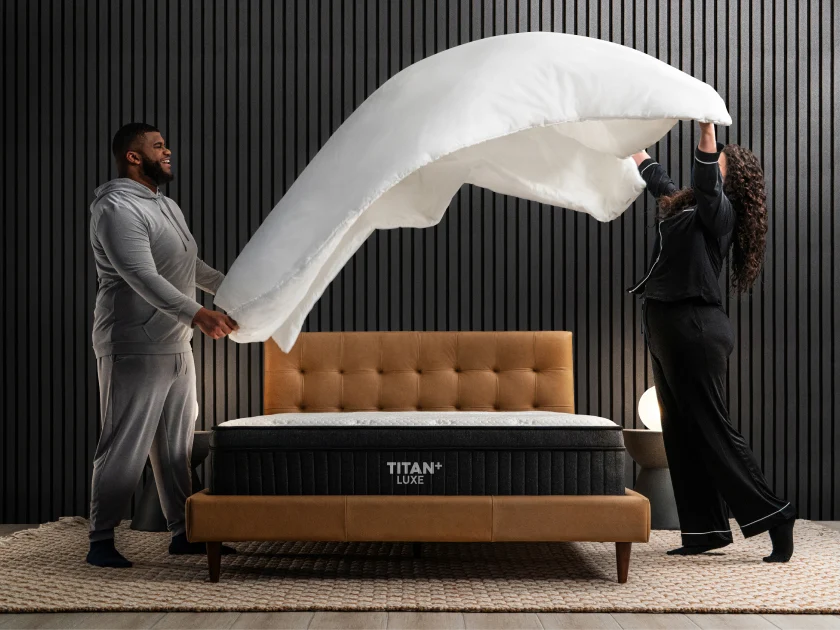
The Titan Plus performs admirably for a mixed-weight couple where motion isolation is concerned. My mother-in-law regularly reports that when they travel and her spouse moves, she, as the lighter-weight sleeper, tends to roll into the middle of the bed.
When they came to our home and tried the Titan Plus mattress, she didn’t feel the movement from the other side of the bed at all.
Now, as I briefly touched upon, this bed is designed to provide an unyielding surface that remains firm for heavyweight sleepers, which means partners who weigh around 130 pounds are not going to get a lot of pressure relief, and they’ll feel like they’re sleeping on top of the mattress instead of in the mattress. This may or may not be a deal breaker depending on how an individual prefers to sleep and what level of firmness they want. It can be too firm for some lighter sleepers, leading to shoulder and hip soreness
Big Fig for Couples
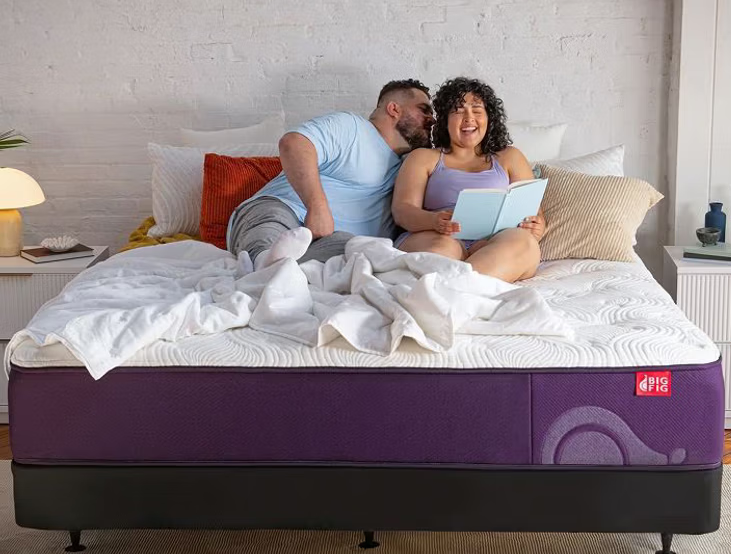
Similarly, Big Fig does a lot to reduce motion from one side of the bed to the other because of the pocketed coil construction. Basically, when a heavier partner shifts in their sleep, the kinetic energy gets absorbed by the dense coils.
The downside here is the hand tufting. Structurally, many people prefer that benefit, but it also means that the entire bed feels more uniform across the surface, so a lighter partner might not feel a heavier partner in bed, but they will notice the slight vibration through that top fabric.
Big Fig is arguably worse when it comes to the discrepancy between a lighter weight and a heavier weight partner because it is a very firm mattress, usually ranked around 8 out of 10 on the firmness scale. However, the company offers a specialized, heavy-duty mattress topper if one partner needs to soften their side of the bed.
Summing Up
Overall, choosing between these two heavy-duty mattresses comes down to your personal preference for warranty, budget, and your sleeping profile.
- Choose the Titan Plus if: You prefer a highly responsive, streamlined sleep surface, run exceptionally hot at night (and intend to opt for the GlacioTex™ cooling cover), and want a highly durable, purpose-built mattress at a more accessible, budget-friendly price point. It is an exceptional choice for strict stomach and back sleepers who require maximum lumbar push-back.
- Choose the Big Fig if: You want an absolute fortress of a bed with maximum edge stability, are looking to invest in a mattress backed by a 20-year warranty with a strict 1-inch sag threshold, and want the physical reassurance of a hand-tufted construction that doesn’t allow internal layers to slide or bunch.